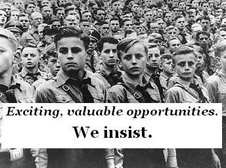
Just to note that I have (or, at least, think I have) disabled comments on this blog - we've not said anything of significance for a while and the spammers have found us :(
S-E

Just to note that I have (or, at least, think I have) disabled comments on this blog - we've not said anything of significance for a while and the spammers have found us :(
 Apologies to the Daily Mail, but this was too good to resist.
And the scary thing is, it's probably less remote from a possible future than one would like to think.
Charles Murray in the WSJ here :
"Education is becoming the preferred method for diagnosing and attacking a wide range problems in American life. The No Child Left Behind Act is one prominent example. Another is the recent volley of articles that blame rising income inequality on the increasing economic premium for advanced education. Crime, drugs, extramarital births, unemployment--you name the problem, and I will show you a stack of claims that education is to blame, or at least implicated."
The truth is, of course, that the most important factor in educational "outcomes" is the intelligence of the pupils being educated. Apart from effectively teaching the majority of schoolchildren to read, write and add-up and enforcing discipline, if only by allowing the majority of pupils to leave once this aim is achieved, there is nothing more even the best school can hope for. That would at least allow the minority of children with above average intelligence to pursue an academic career unmolested by those of a more prosaic outlook. The idea that education can be used to pursue some form of social engineering is arrant nonsense and dangerous to boot.
As Murray says:
" That says nothing about the quality of the lives that should be open to everyone across the range of ability. I am among the most emphatic of those who think that the importance of IQ in living a good life is vastly overrated. My point is just this: It is true that many social and economic problems are disproportionately found among people with little education, but the culprit for their educational deficit is often low intelligence. Refusing to come to grips with that reality has produced policies that have been ineffectual at best and damaging at worst."
Scottish schools broke up at the end of June but I'm just back from sunny Buckinghamshire where my niece has just finished her first year at the local grammar. I appreciate the sort of people who support this blog are unlikely to agree with this but as far as I'm concerned, the crucial benefit of grammars, as with private schools, is that not everyone goes to them. In comps we take the lot, have to take the lot. A melancholy thought that sometimes floats through my brain is that tomorrow's rapists and murderers have to go to school somewhere - and I think I've seen a few of them.
Anyway, since it's been in the news recently, I thought I'd share a wee tale from Glasgow East where I was teaching last session. It's not that I don't think conditions like ADHT or dyslexia don't exist - it's just that they tend to be over-diagnosed. There are two reasons for this, in my view. One is that ordinary mechanisms for social control have been progressively delegitimized by people often described as, um, progressives. Hence the tendency towards the medicalization of mundane social problems. (LBS - lazy bastard syndrome.) The other reason is there are incentives involved. Those diagnosed with such conditions get Learning Support, extra time in exams, general excuses made for them and so on.
So when you're told that a pupil has ADHT, I have to confess my initial response is to say, "Yeah - right." Not always though. When I was informed that a particularly 'challenging' pupil of mine had this condition, I said, "Are you sure that's all that's wrong with him?"
Because he was, I'm sure through no fault of his own, mental. And I mean totally. Completely unteachable, almost uncontrollable, took tantrums - the works. He was, for example, chucked out of the final exam in my subject after about ten minutes. It takes a special kind of loon to achieve that.
Anyway, towards the sunny end of term, a couple of us were doing a little al fresco smoking as is our want obligation when we noticed our friend - let's call him Kevin McDiddy - wondering into school after the exams. Since he's over sixteen and has hitherto done a very good impression of someone who loathes school with every fragment of his DNA, we wondered what the hell he was doing there. Buying a senior school tie is what he was doing. He thinks he's staying on! It's not that pupils like him don't hate school - they just hate the idea of leaving and having to organise something else to do - like working - even more. I hope his 'pastoral care' teacher has disabused him of this whole staying on plan of his - although these days you can never tell. Anyway, you'll have guessed already the point I'm going to make. Imagine a situation where the school was obliged to take him for another two years. But if you teach in an English school, you won't have to merely imagine much longer. Two more years of compulsory education; what a mental idea. As mental as Kevin McDiddy as a matter of fact.
Our New Messiah's education policy is here. More tedious detail here, for those with the stomach for it.
A particularly nauseating bit is this, I think:
"Zero to Five Plan: Obama's comprehensive "Zero to Five" plan will provide critical support to young children and their parents. Unlike other early childhood education plans, Obama's plan places key emphasis at early care and education for infants, which is essential for children to be ready to enter kindergarten. Obama will create Early Learning Challenge Grants to promote state "zero to five" efforts and help states move toward voluntary, universal pre-school."
Now I know that the word "voluntary" is used but seriously, how long do you think it would remain so with all that nice federal money available? Not to mention all those government jobs and power. Power over other people's children.
Remind you of anything? This perhaps?
"Teachers are directed to instruct their pupils... and to awaken in them a sense of their responsibility toward the community of the nation.*
No?
Then possibly this:
"The education of all children, from the moment that they can get along without a mother's care, shall be in state institutions at state expense."**
Or this:
"We must create out of the younger generation a generation of Democrats. We must turn children, who can be shaped like wax, into real, good Democrats.... We must remove the children from the crude influence of their families. We must take them over and, to speak frankly, nationalize them. From the first days of their lives they will be under the healthy influence of Democrat children's nurseries and schools. There they will grow up to be real Democrats."***
Nationalization of education is exactly what Obama is talking about. Central government control of education, presumably a national curriculum, set text books, teachers employed by the federal government rather than local school boards, targets and political interference. Yeah! That should work! It works in Britain after all!
It all goes to show that nothing can fail so badly that some idiot politician can't make it worse.
*Bernhard Rust, Nazi Minister of Education;from "Racial Instruction and the National Community," 1935.
**Karl Marx, "The Communist Manifesto"
*** Communist Party Education Workers Congress (1918) (Obviously I've changed "Communists" to "Democrats").
(There is a posting over at Samizdata by Johnathan Pierce on the topic of school holidays, child labour and youth crime).
The weekend just gone, I spent much of Saturday visiting my old school that is shortly to be demolished due to a move into a new PFI school next door.
I spent much of the time chatting to teachers about then versus now. With a couple of them, I shared my own experiences of getting bored during my 6th Form and coasting towards failure. I was reassured that this would be recognised and handled properly these days, through various means such as gifted & talented schemes, mentoring or behaviour support.
Of course it was recognised and handled in my time through a combination of carrot & stick, the stick being a leather strap. One application of the latter (for persistently failing to hand in homework) was sufficient to ensure I avoided getting another leathering.
On reflection though, it was (and remains) a cure for symptoms, not the actual problem that I didn't actually want to be there at the time even though it seemed a good idea the year before.
Some of the real reasons for educational conscription and why it is an expensive failure here.
H/T David Thompson.

Googling “raising of school leaving age” leads me to discover that Bermuda has just decided to imitate the UK government’s plan to force young adults to spend an additional two years at school. Clearly inspired by the example of our own Labour Party, Bermuda’s ruling Progressive Labour Party seems to think that improvement of a coercive state system, which is creaking under the weight of existing unmet targets, is best achieved by expanding the aims and powers of that system still further.
Education Minister Randy Horton announced yesterday … the dates of a series of meetings he plans to have with parents, students, principals, teachers and Ministry of Education officials. Mr. Horton said those attending would be told of a number of amendments planned for the Education Act, including raising the mandatory school leaving age from 16 to 18 and giving the education board more power ...
The Minister was asked if the idea was to reduce youth crime by keeping youngsters occupied. He said: "Certainly, we hope that that will help in that way. The important thing is improving the quality of teaching and learning at schools."
Government pledged to bring about improvements after UK professor David Hopkins and his team carried out a review of public schools early last year and concluded that the system was on the "brink of meltdown".
... Mr. Horton also spoke about claims from the Bermuda Union of Teachers that classes were being left uncovered due to staff absences. Union leader Mike Charles shared internal memos with The Royal Gazette — as reported yesterday — showing how one school had three classes uncovered on two consecutive days this month.
Perhaps Bermuda will implement their ROSLA scheme before we do, giving us a chance to back out once we see what the initial effects are.
"Some consortia suggested they were finding it especially difficult to get employers involved while the content of the Diplomas was not known, as partnerships were themselves unclear about employers’ potential contribution; employers understandably want to know precisely what is being asked of them and when. However, only the Level 3 Diploma requires sector-specific work experience; at Levels 1 and 2 work-related learning is focused on employability and need not be work experience related to a particular sector. Partnerships therefore have some flexibility in setting up a sufficient amount and range of work-related learning and work experience"
Para 79 from this
H/T Wat Tyler
The topic of educational conscription in PMQs:
Do you believe in education till 18? the PM responded.All very dignified. Not. But at least the subject this group blog has now moved to the very top table of politics!
Do you want A-levels in the long term? asked Cameron.
Do you believe in education till 18? said the PM.
Why won't you give me a straight answer?! from DC.
Was it Orwell who said the best books are the ones that tell you what you already know? You could say the same about research and experience; it's always nice when the former confirms the latter. Chris Dillow has some here.
Leaving aside for the moment the morality of forcing young people to attend courses or training they neither want nor need, does educational coercion actually exist and if so why?
No one would argue that the law says your children have to go to school until the age of sixteen. In practice the chances of a parent falling foul of the law are extremely low. A law which is not enforced is no law at all.
Never having thought about this issue very much until recently I had always presumed educational coercion was originally aimed at that minority of parents who do not value education and would not force their children to attend.
There are a number of problems with this, of course. The law is aimed at all parents and yet the majority would send their children to school anyway. What's the point of threatening people who are only too happy to do what you want anyway? Secondly, the minority who do not value education are probably members of the "poor" and therefore as far as our political masters are concerned, not responsible for their own actions, hence the ineffective enforcement. I know of only one person in my area who was ever imprisoned for failing to send her kids to school and this was after literally years of warnings, visits from officials and threats. She knew she was unlikely to be held responsible for her children's truancy and frankly did not expect to be. Thirdly, you can force a child to attend, but you can't make it learn. All that will happen is that it will disrupt education for those who do wish to do well. So not only is educational coercion a bad idea, on the whole, but in practice it only applies to those who already do send their kids to school. If coercion doesn't help the children of the poor what is it really for?
Utilitarian arguments appear to be being used to justify the present proposals, "equipping our young people with the right skills" etc. This argument needs turning on its head. There is no evidence that coercion makes any difference at all in fact it is probably counter-productive. The absence of disruptive and disaffected influences in the classroom are bound to have a beneficial effect on the majority of pupils.
Then there is the question of the often appalling quality of state education and the morality of forcing people to attend. Why is it so bad? The Gray Monk may give us a clue:
"One of Labour's favourite "Think Tanks" has just published a report I would find risible, if it were not for the fact that it is intellectually and morally insulting - quite apart from the fact that it is so blatantly twisted against anything English, or for that matter, "British". The thrust of the report is that our history is so shameful we should not teach it to our children, that they should, instead, be taught about everyone else's history and how noble and good they were as they struggled to overcome our evil doings.
As I said, insulting and frankly anti-British."
Read the rest here. I would only add, why should our children be forced to put up with this type of mendacious crap?
Why is coercion persisted with? Simple. Lust for power, empire building and a desire for monopoly supply. It was ever thus. Here is the Superintendent of Public Instruction in New York, commenting in 1871, on the proposal to make school attendance compulsory:
"It is palpable that the prominent defect, that calls for speedy reformation, is not incomplete attendance, but poor teaching…. I speak of the needed improvement in the particular mentioned, in comparison with compulsion, as a means of securing attendance; and I contend, that, before sending out ministers of the law to force children to school, we should place genuine teachers in the school room to attract them ... the improvement in question should be made before resorting to the doubtful experiment of compulsion. It cannot be done suddenly by legislation."
Naturally the Superintendent did not get his way. Much easier for teachers and officials to make attendance mandatory than to make schools attractive and useful enough to make parents want to send their children there and for the children to want to go.
The real reason then, for educational conscription is the desire for monopoly and control. This is why independent schools are regularly threatened with the withdrawal of their charitable status or even outright abolition. The problem is state control and coercion so what we need, obviously, is more state control and coercion. And what will we need when these latest proposals turn out to be another expensive failure? More state control and coercion, of course. What next? Newborn babies being taken from there mothers for their own good perhaps? Oh no, that's already starting to happen isn't it...?
*We don't have a secondary school in my town anymore That is, it's called something else now. Something much more important sounding. Can you guess? Here's a clue: Parlance Musing (8,6) anag. First correct answer gets to punch Alan Johnson on the nose while I hold him down. Luckily our political masters think some traditions are worth preserving. The education's still crap.
The proportion of middle class children going to university has grown under Labour:The educational gulf between rich and poor has widened over the last 20 years as more middle-class teenagers go to university, according to a report published today...
So charging loads of money for students to go to university has increased the proportion of middle class children going to university. Who'd've thunk it?! After all, when it's going to cost so much, many "working class" people would prefer to just earn now. Especially considering the devaluing of the worth of a degree and the continual rise in the cost of getting one.
Reforms introduced since 1997 - such as an increase in choice between state schools - has provided even more "opportunities for middle-class parents to seek social advantage", said the study...
Between 1990 and 2000 the proportion of students from skilled manual or unskilled backgrounds going to university grew from 10 to 18 per cent, said the study, while the proportion from professional backgrounds grew from 37 to 48 per cent. (The Telegraph)
Middle class parents will be far more willing and able to financially support their offspring, and the extra loan that those whose parents don't earn much can get doesn't really help - since it has to be paid back as well.
So Labour have driven an increase in the middle-class domination of universities. Most certainly not what they had in mind.
ThunderDragon
Cross-posted at my blog.
Sixteen and seventeen year olds are not old enough to decide for themselves whether to continue in education, but they are old enough to vote.
Some of those who support this government's proposals for raising the educational leaving age argue that it is both liberal and utilitarian. Intellectual dishonesty, or simply ignorance of what the word liberty actually means, prevents them from saying what they actually think, which is the limitation of freedom that these proposals would entail is justified on utilitarian grounds.
My own view is that while a commitment to liberty properly understood should be enough to oppose this latest proposed ROSLA*, I think it's worth emphasizing that it is unlikely to provide much utility to pupils who would have otherwise left at the age of 16.
The two are, of course, related. One of my main frustration when reading much of what journalists and bloggers have to say about education is that they fail to do justice to what I think most teachers, at least in my experience, would argue is the single most significant barrier to learning in our secondary schools - which is indiscipline. Most of this has to do with the fact that our 'compulsory education system' doesn't provide the teacher with much in the way of mechanisms or sanctions that might be used for the whole compulsion thing. In reality, it is only attendance that is compulsory - although success even in this area hasn't been exactly universal.
None of this is acknowledged by advocates of raising the school leaving age who, having confused causation with correlation, believe the benefits of a further two years of education will be conferred to all simply by forcing everyone to attend senior school. I don't think anyone from the ROSLA camp - those who have had teenagers described to them - has given a moment's thought to what impact on our schools these proposals might have. This brings me to the Christmas leavers...
Christmas leavers are those pupils whose parents, for reasons best know to themselves, enrolled their children when they were four. This means they have to wait until they've completed part of what is fifth year in Scotland before they are 16. They can be a bit of a pain sometimes, frequently bringing to senior classes the sort of behaviour that disrupts much of the teaching in the lower school. But they have this saving grace: Christmas leavers are those that assume nothing is to be gained from prolonging their education longer than necessary. This is why they leave at Christmas without bothering even to hang around for the next six months or so that would take them up to the exams.
This is where I take strong issue with those advocating raising the school leaving age. In ten years I don't think I can recall one instance where I thought the Christmas leaver's assessment of their own educational prospects was mistaken. Rather with these it is invariably obvious that the law of diminishing returns had set in usually at least a year before they turned 16 and while we bear them no ill-will, we are as glad to see the back of them as they are of us. Implicit in the government's plans to raise the educational leaving age is the belief that they know better than the 16 year old. Now while 16 year olds lack knowledge about many things, there is one area where their understanding is undoubtedly superior to HM Government - unlike ministers, they know what schools are actually like.
*The present Scottish administration, despite it's many shortcomings, have decided not to inflict this nonsense on Scottish schools, thank goodness, so I can't be accused of being too self-interested here.
Rather than the educational conscription proposed by the government that myself and the others [such as Fabian Tassano, Surreptitious Evil, and Devil's Kitchen] who write this group blog are constantly arguing against, it has now been suggested that children should have the opportunity to leave school at 14 - by the head of the UK's biggest education authority, no less.
His point is that, very simply, some children are not academically gifted and are not suited to classroom teaching and learning - and as such would benefit far more from apprenticeships.Some 14-year-olds will probably be better off in some kind of apprenticeship...
The response of the NUT that the earnings of those who stay on and get qualifications is "much higher" than those who have "simply left school very early and gone on to do some very specific training." Yes, it may well be. But those who leave school at 14 will not be the kind of people who benefit from classroom learning or those who are likely to be suited to do the jobs that require high qualifications. They are the people essential to our society - plumbers, electricians, builders etc. - without whom our modern society is screwed. That the NUT believe that qualifications are essential and required in order to live a useful and productive life betrays their love of the testing regime.
That's how they will get success...
[W]e need to cater for the range of people and the range of jobs we all have in society.
Not everyone can have high qualifications and great high paid jobs. And not everyone is suited to them. It's a simple fact of life.
However, at the very least, children shouldn't be allowed to leave school at 14 unless they have an apprenticeship to go to. I'm not entirely convinced by the idea that children should be able to leave school so early, but it is certainly far better than forcing them to stay there for longer. At least they then have the choice to make, the choice which this government seems determined to take away from 16-18 year olds.
ThunderDragon
This post is cross posted at my blog.
Dr Gordon Brown: (my emphasis)
My Government is committed to raising educational standards and giving everyone the chance to reach their full potential. … A Bill will be introduced to ensure that young people stay in education or training until age 18.
My Government is committed to providing a healthcare system organised around the needs of the patient. … Legislation will be introduced to create a stronger health and social care regulator.
My Government will bring forward proposals to help people achieve a better balance between work and family life. … A bill will place a duty on every employer to contribute to good quality workplace pensions for their employees.
My Government will take further action to create stronger communities and tackle terrorism. … My Government will seek a consensus on changes to the law on terrorism so that the police and other agencies have the powers they need to protect the public …
Re the counter-terrorism Bill: “we welcome it”.
Re proposals to coerce adults to receive ‘education’ or ‘training’ (as defined by the government): “the Government are going backwards [by] abolishing the A-level”.
Media puff for the coercive education of adults:
“Important … genuinely radical”
The Independent

In a parallel universe:
Leader of the Opposition:
We are suspicious of the right hon. gentleman’s proposed counter-terrorism Bill. We suspect he has no real respect for well-established principles of liberty, and merely seeks to increase state powers in line with his ideological commitment to boosting collective rights at the expense of the individual. We are not convinced there is a case for doubling to 56 days the period during which a British citizen may be held by the police without charge.
We regard it as a wholly inappropriate response to declining state school standards that individuals should be forced to attend them for even longer. Such a breach of liberty would — if it were to be acceptable at all — require a long drawn-out period of debate, and very strong evidence that it is a sound remedy for a serious problem, and we have had neither. On the contrary, the Professional Association of Teachers have already expressed their strong objections to criminalising the non-attendence of seventeen-year-olds.
Further reading: (see esp. the comments)
Stumbling & Mumbling
Liberal Conspiracy
Crossposted from DSTPFW, some sterling satire from George Szirtes.
A Statement from The Ministry of Truth: Education (Schools) Department
We are living in glorious times. Our children are ever better qualified, their future – and ours – ever brighter. 99% of all school leavers have four A levels or more. The numbers of those claiming benefit after leaving school have gone down and down. We confidently look forward to a time when everyone goes to university and no one is claiming benefits. The super-heads we have appointed to rescue the very few schools that were failing have utterly transformed those institutions. Their students come to school enthusiastic and leave enthusiastic. Our policies have empowered such wonderful dedicated heads and their extraordinarily talented and hard working staff, who have received the best training, training of hitherto only dreamt of standard, to maximise their potential, to turn chaff into wheat, to feed the hungry, to top league tables and to put this country at the very head of academic achievement.
There remains, however, an almost insignificant minority of failures: schools where the heads are weak, where they fail to sack their incompetent teachers, and, as we know, there are few people more incompetent than incompetent teachers, teachers under whom little or nothing of value gets done. Indeed it is worse than that. This tiny minority is a drain on our resources: they damage your children, they ruin our figures. We have to extirpate these parasites, weed them out, drag them kicking and screaming from the soil they are bent on holding on to and destroying. If we do not act now this country will go to the dogs. They, and they alone, are responsible for the upbringing of our extraordinarily talented and hard working young people, and we must make an example of them. As the first step in this process one in every five teachers in all schools will be taken out and shot. Once this is done the country can go forward and enjoy the fruits of our brave and radical policies, including, I am delighted to announce, the new school-leaving age of twenty-five.
In addition to my diatribe yesterday on educational conscription, something has just occured to me - this law will apply only in England. Only English children will have to stay in school until 18. Only English children will be deprived of their liberties and their freedom.
As such, when this law comes before Parliament, not one MP for a Scottish or Welsh constituency had better vote. This does not apply in their constsituencies, so I do not want to see them force two years of extra schooling onto English children but not those in Scotland and Wales.
That they even could do it illustrates the issues with our current devolution system.
Cross-posted from The ThunderDragon