25 June 2007

Random Inequality

Googling for "return to grammar schools" (with quotation marks) produces 2060 results, almost all negative - NO return to Grammar schools. Googling for "return to secondary modern schools" (again, with quotes) produces no results at all.

I know this is an imprecise survey, but it's still meaningful. We live in a society in which it is unremarkable that people should say "No more good schools", but nobody should say "No more bad schools". As it has turned out, the comprehensive system has actually ensured that now almost every English child goes to a Secondary Modern.

It seems that the "almost" in that last sentence rankles with some. Brighton Council has said it will allocate children to schools by lottery, to prevent Middle Class parents making a school outperform others in the area by moving within its catchment area. There have also been calls at the national level to force independent schools to admit a quota of disruptive pupils.

These initiatives will have a predictable effect: to make good schools worse without making bad schools better. The arrival of a handful of intelligent, well-motivated pupils in a school with disruptive pupils can have no effect whatsoever; the arrival of a few disruptive pupils in a high-performing school will ruin the education of every child on the roll.

Making schools worse does not make things equally bad for everybody. The wealthy can still hire tutors, send their children abroad or otherwise ensure they have a good education. As the rest of the population slides further behind, the gap widens even further. Thus, these initiatives designed to further equality have precisely the opposite effect.

What makes this inexcusable is that we did have a period, ending in the late 1970s, when social mobility was higher, and this was the consequence of the Grammar School system and the Direct Grant. So we actually know, experimentally, that reversing the current education policies would create greater social mobility and improve standards - for everybody: A report published through the LSE reviewed the real life laboratory experiment that the continuation of Grammar Schools (with reformed entrance arrangements) in Northern Ireland up to the present has provided. It shows that:

Using administrative data before and after the reform, we find that the open enrolment reform of 1989 (which affected the 1979 birth cohort) had a clear impact in Northern Ireland relative to England. A 15 percentage point increase in the number of pupils enabled to attend grammar school (at the age of 11) was accompanied by shifts of similar magnitude in the number achieving five or more GCSEs at A*-C and one or more A-level. This suggests a strong causal effect of expanding the more academic track on overall educational achievement.
[...]
Although this research cannot be interpreted as evaluating the overall effects of a comprehensive or selective (‘tracked’) system of education, it is an example of where widening access to the more academic track has generated positive net effects. It illustrates the high price that pupils pay for being excluded from the academic track, even when they are some way down the ability distribution within their birth cohort.

The study also provides clear evidence that selection into the more academic track really has a causal impact – the improvement in educational outcomes is not simply an artefact of the selection process.
On Radio 4 this morning, John Humphreys interviewed David Cameron about a Sutton Trust report that showed social mobility has declined. A child born in 1970 was less mobile than one born in 1958. This can be paraphrased as follows: A child born into a society with academic selection and centres of excellence open to all on merit alone had a greater chance of social mobility than one born into today's Comprehensive system.

Humphreys advocated the Brighton lottery appeal. Cameron disagreed, but said there should be "No return to the 11 plus". "A lottery is completely fair," remonstrated Humphreys.

In fact, a lottery would be (almost) completely random. Random is not the same as fair and it's strange that anybody should conflate the two.

But it's much more strange that neither man advocated a return to a system of education that we know - from experience - works better than the present one.

It's also plain that when the established media and both major parties advocate educational policies we know, from experience - from experiment - can only fail, we're in trouble.

20 June 2007

Infantilise the Adult. Children Made Adults.

I am very concerned that schoolchildren are being involved in teacher interviews.

While the government sets about infantilising the adult population, there is this perverse mentality of denying that children are children by giving them a kind of faux-adult authority. There is a worrying alarm bell that goes off in the back of my mind when I hear of such things. It is like there is a perverse and even perverted "trojan horse" at work. Frankly, it has echoes of the Red Guard in China that was used to break the authority and respect in the child-parent and child-teacher relationship, leaving only the child-State relationship in place.

The NASUWT are not keen on the idea, either. I agree with their stance that it undermines and deprofessionalises teachers. Children are not a teacher's peer-group. They are NOT the "customers" either, even though this appears to be the implication. That position is held by the school, its Governers and the wider body of parents.

The question I have, though, is where this is coming from? Who is drivng it? I cannot see that it is coming from teachers or headteachers. LEAs? It seems one body is partly responsible - Peoples School Soviets School Councils UK. This is an "independent charity", though I suspect it may receive most of its funding from the Dfes. It appears to want to make it law (oh, the Sociofascist hand at work) that all schools be required to have a School Council. Question: If it is such a good idea, why the need for law?

I feel it might be worth digging deeper into just who are these people. They may do some things right, but the way they appear to go about it - this fake independence - gives me the creeps.

13 June 2007

"Make hard work trendy" says Government

Guest author Bel on another attempt by the Labour government to enforce compatibility between what happens in schools and the il-liberal cognoscenti's latest thoughts on what's ideologically desirable. Social engineering, social engineering, social engineering. People left to themselves just will not behave in the way they ought to, so they will have to be compelled ... (First published at Bel is Thinking.)

From the Daily Mail, we learn that the Department of Education has ‘called on teachers to create an atmosphere in which it is trendy to work hard and “boffins” are not bullied for being too brainy.’

Yes, teachers and all those in authority should ensure that bullying is stamped out in any place where they have a say, whether or not it is a ‘boffin’ being bullied, so that goes without saying.

I am more interested in this new assignment to teachers to ‘create an atmosphere in which it is trendy to work hard’. For starters, if any school can achieve this, it will be the first school ever on the face of the earth to do so. Schoolchildren have never, since the beginning of time, seen hard work as ‘trendy’, and they are not about to start now. In any case, I do not think they should be encouraged to do so. They are children, after all, and it is only to be expected that there are some things (school work, etc) that they will not embrace with the same enthusiasm as they do other things (playing, etc).

In addition, the notion that something must be made ‘trendy’ before we can encourage our children to do it, is something I find baffling. What about instilling in them the idea that hard work may not be fun, but in the end, it yields the fruits of success, a sense of achievement, and respect among peers? What about the idea that applying oneself to something, whatever the difficulties, frustrations, and challenges, might be something worth doing? What about the idea that sometimes we may not feel like doing something, but that self-discipline and dedication, irrespective of the views of others, are values to be exalted in every case? These are the lessons we should be teaching our children.

By trying to get teachers to pretend that hard work is ‘trendy’, the Department of Education is sending out a message that nothing is worth doing unless one can get superficial pleasure from it. They are preaching to children, telling them that they can attain things in life on their own terms. This is grossly irresponsible. Children do not rule the world, and sooner or later, they will learn that ‘trendiness’ does not make things happen. Far better to put trendiness in its real place, as a sometimes fun, often times diverting, ineffectual concept. In the real business of life, there is very little room for trendiness. There are many issues in this life in which the views of children are irrelevant. They need to be told that some things (eg hard work) are necessary, whether or not they are trendy. And they need to be told why.

Children should be encouraged to reach out for the tray of goodies that life can offer. However, with all this ‘trendiness’ talk, what the Department of Education is doing is kneeling at the feet of children and offering them the world on their (the children’s) own terms. Instead of encouraging them to aim high, and reach for a world outside their own, the Department is reshaping the valuable things in life so that they accord with the fleeting values of children. This I find surprising, and somewhat saddening.

Bel

27 May 2007

Edukashun, Edookayshen, Education

Tom Paine highlights the politically fashionable, but misplaced, hostility to grammar schools. So if we are to have compulsory education for 17-year-olds, it looks increasingly likely that (for those whose parents are unable to scrimp for private) it will be within comprehensives — the only model which can pass prevailing ideological criteria. (First published at The Last Ditch.)

Link: Willetts must have known it would horrify Party.

All three comment pieces in the Daily Telegraph today [17 May 2007] were about the Tory Party and grammar schools. Alice Thomson says it best however, with these words

The Tories seem to have ditched what they always held dear - a belief that those who worked hard and were talented would be rewarded - to embrace the socialist principle that all must have prizes
Boris Johnson, usually the Conservative Party's voice of sanity, for all his Eton-nurtured capacity for intellectual wrangling is unable to save the party from Willett's appalling gaffe. It was a speech that did not need to be made. No potential Conservative voter is pleased by it. Secretly, I suspect that, despite the huge opportunity presented for mischief - a goal so open that even the talentless Prescott couldn't miss it - few Labourites are either.

For Conservatives, health is the third rail of British politics. In our hearts, we know that only Labour could ever reform the National Health Service. The Conservatives have only to mention it for voters to panic. One day, God willing, it will be Labour's destiny to clean up the mess it made of British healthcare. The last 10 years have simply shown us that it is not yet that day.

That is not true for education. Comprehensive schools are a greater disaster for Labour voters than for Conservatives. The working classes of the North of England have no hope of buying themselves either into a private school or the catchment area of a less foul State school. A Conservative government could, by reforming schools, do something for them that Labour never can, because education is for them as the NHS is for us. They are secretly waiting for us to solve the problem.

Until Willetts put his foot in his mouth, that hope alone kept alive minority Tory votes in Labour heartlands that could one day have been built upon. No-one even seems to have noticed that many of our immigrants in the past 20 years are from communities, such as the Indians and the Chinese, who value education much more highly than the native English. Their votes are up for grabs too. Immigrants are naturally more aspirational; naturally more Tory.

Boris tell us that the end of Grammar schools was politically inevitable in a democracy because;
it became an arithmetical and electoral certainty, over time, that the rejects outnumbered the successful
What tosh. He should not fall into the elitist trap of describing those who failed to get into Grammar Schools as "rejects." In doing so he defames the work of generations of dedicated teachers who were able to provide excellent education to those who went to Secondary Modern schools; education carefully targetted to their abilities.

I was taught by some of them. I took the 11+ but my area went comprehensive that year and I was never told the results. Instead, I was sent to the local secondary modern school - rebadged as a comprehensive. There were some superb teachers there, doing their best. They were as bemused by me as no doubt the Grammar School teachers in the next town were by some of their new intake. However, they had long shaped the destinies of the majority of children in my town. Their former pupils were respectable, hard-working and better-educated than their children and grandchildren are today. They are the ones failed by Anthony "I will close every fucking grammar school" Crosland's public school ultra-leftism, every bit as much as people like me.

As for the electoral arithmetic, what defeatism on Boris's part! The kind of ignorant chavs who think that selective schools are wrong because their little Shane, Wayne or Sheena will never pass an exam will not only never vote Conservative, but will probably never vote at all. They are irrelevant. It's all about triangulation, Boris. Margaret's policy to steal Labour votes was to sell council houses. Everyone was astonished by the aspirational instincts she unleashed in the Labour heartlands. Your equivalent could be the restoration of educational opportunity to the working class.

No-one, in their hearts, truly believes in comprehensive schools. Don't listen to what Labour politicians say about it. Look at what they do when it comes to their own children. Cherie Blair, Diane Abbott, Ruth Kelly and Polly Toynbee would be secretly delighted if selective State education was brought back. Of course they won't say so. They will kick, scream and defame, but so what? Triangulate them and move on.

Willetts has a point to precisely this extent. It is best not to hark back to the past. We should not speak of "Grammar Schools" or "the 11+". We need new branding and some less crude (and less final) selection mechanism. If he will apply his two brains to devising such a system; one that Kent Conservatives would accept instead of their Grammar Schools, he will be on to an election-winner.

More than anything else, this is what the Conservatives can do for Britain's future. No nation can long survive the huge waste of human potential represented by the present system. To compete in the world, we need to maximise the potential of every pupil. Even the Socialists know it in their hearts. Even as they ranted against us, they would be secretly, guiltily glad that we had saved their grandchildren from Crosland's evil legacy.

Tom Paine

18 May 2007

Boys are into just 160 books?

Alan Johnson has published a list of 160 books in an attempt to get boys to read more for pleasure and to keep up with girls. The £600,000 project is giving every secondary school the chance to twenty books from the list for free. That's good, except for one thing. It is a government made list.

'Boys into Books', as the scheme is called, is aimed mainly at boys aged between 11 and 14 because "research suggests boys enjoy reading at primary school but lose interest after the age of 11." The list includes authors such as Philip Pullman, Anthony Horowitz, Terry Pratchett and Jeremy Clarkson but is lacking any J. K. Rowling (who has through her Harry Potter series - book 7 out on 21st July! - alone got many children into reading), Charles Dickens and has only one Mark Twain - Alan Johnson's favourite, Tom Sawyer.

The idea is a good one. Boys should be encouraged to read more as it will improve the quality of their English and provide them with non-electrical means of entertainment. But it is flawed in so far as that it is a government-produced list. Why not instead just give each the chance to get twenty books of their own choice? Schools and teachers are far better placed to make the decisions on what the children in their school are going to want to read and what is going to motivate them.

Yes, you can say that there are 160 on the list, a large enough choice, surely? Yes there is, and no there isn't. Why are these 160 books so far superior in getting boys to read? They're not. If schools had the choice of any twenty books they wanted, with this list as a 'guide', then that would be better for all. Some school libraries may already have all of these books, after all.

The books on the list may have been "drawn up by librarians, who had carefully researched what books excited this age group of boys" but it's not the be-all and end-all of it. This programme, when limited to 160 books, is not much more than a publicity stunt and a chance to grab good media headlines. Just give schools more money to spend on books aimed at boys and the best outcome possible will arise for them - but that just wouldn't get Johnson so many headlines, would it?

The ThunderDragon

Sources: The Times, BBC, The Telegraph

14 May 2007

More on How To Sell Conscription

Guest author Paul on how coercion will be marketed to appear cool and fun.

In a previous post, I looked at one tactic used by the government to sell these malignant proposals; namely, to persuade people that not to accept the plans would constitute a shameful neglect of helpless young people. Fabian has since highlighted another prong in the governmental attack — attempting to convince the populace that the sky will fall in if the proposals are scrapped; that Britain will cease to be competitive and will sink inexorably into economic decline.

The methods thus far have been negative — why it would be A Bad Thing to reject the proposals. Has the government got anything a little bit more positive to offer?

Well, this goverment site dealing with post-sixteen education is suggestive of the way in which educational conscription will be sold.

Firstly, there's the mention of choice: currently one does actually have the choice to sever ties with state education at sixteen, but if conscription goes ahead, there will be no such choice. Expect to see increased use of the words "choice", "options" etc.

Secondly, there's the bribe. Advertised immediately below the title of the page. This'll probably be retained to soften the blow of conscription.

Finally, just look at the page: although it is meant simply to be a government information site, it has the appearance of a "lifestyle" brochure — happy, smiling faces; people dancing, people laughing. Forced post-sixteen education is something you're gonna love! And notice there at the bottom of the page, the acme of lifestyle choices. University. The final enticement is the prospect of living the student dream: never mind the colossal expense or just how likely you are to use that degree — no, you'll belong to the best social identity group of all. Incredibly there's even a page devoted to promoting that package holiday for chattering-class youth, the gap year. And promoting is the word, here: follow the link — there's no hint that taking a gap year might not always be such a wonderful idea.

Choices, sweeteners and unending fun. Oh my! Conscription has never looked so appealing.

2 May 2007

Does the UK need “more skills”?

The idea that, in the words of the Green Paper, the UK economy “will increasingly demand more highly skilled employees” is regularly trotted out to justify the relentless expansion, at the taxpayer’s expense, of “education”.

As far as I’m aware, no political party now questions (or dares to question) this principle. But it strikes me as hopelessly undefined, unanalysed, unsupported by hard data, and probably false.

It depends, of course, what you mean by “skills”. We could probably do these days with slightly better language and basic maths abilities among young adults. But those abilities aren’t what are acquired (or ought to be acquired) in post-GCSE or higher education. They used to be acquired in primary education, but are now apparently beyond the abilities of most state school teachers.

So the global economy is changing, it is said, and the UK’s role within it is changing. The decline of UK manufacturing, and the rise of the service sector will (let us assume) continue. But that could equally be an argument for less education/training. If the sorts of skills being used in the average British job of the future have more to do with doing stuff on computers, then this might reduce the need for formal skills to be acquired in schools and universities. Chemistry? Not needed because chemicals/textiles/etc sectors have moved overseas. French? Not needed because globalisation makes English the universal language.

I’m not trying to argue for less “education”, not in this post anyway. My point is that the opposite claim has become a maxim for which no meaningful justification is apparently required.

If any specific new skills really are needed for the “new economy”, it seems to me these are likely to be IT-related. But IT is certainly not what the vast majority of undergrads are studying these days. (And to the extent they are, I doubt that what they’re learning is much use in this connection, except for specialised IT-industry jobs.) And IT is not going to be what the new population of coerced school students would be studying.

Could someone please direct me to some actual cogent reasoning in favour of expanding state-financed education? Something less handwaving than the usual “New Economy … different skills … more training … cannot compete”? Oh, and also, could there please be included some compelling reasoning why there is then also a market failure, i.e. the economy will not automatically respond to any putative need for more skills, say by the private sector offering training courses?

25 April 2007

Teaching the Wrong Message - The General Teaching Council

Some of you might recally the "Chaos in the Classroom" show on C4. Well, the General Teaching Council has their panties in a bunch over the supply teacher who filmed one of her classes - or should I say one of the 40 minute stretches where she shared a room with a group of disinterested, disruptive, rowdy teenagers.

Mrs Mason is charged, amongst other things, with professional misconduct because she blew the gaff "all of her attention should have been directed at the education of the children."

Are those on the GTC imbeciles or people with experience of communicating a valuable lesson to others?

Their stance appears to be about covering their position or the failings of their members, the failings of the New Labour administration, a QUANGO or two or it may well be just that their failing dogma has been exposed for the utter fraud it is.

Mrs Mason should be congratulated. Mrs Mason should receive an apology from the GTC for being expected to deal with a class in such disarray.

23 April 2007

Local authorities putting young people at risk

Whenever the state claims particular expertise or authority about children and young people, it's both instructive and depressing to see how well it discharges its responsibilities for those young people unfortunate enough to find themselves in its care.

I'm willing to accept that many of these children and young people have been badly damaged by the events that necessitated their going into local authority care in the first place and that this may well be a factor in their low educational achievements and the high danger they'll find themselves in trouble with the law at some stage, but it's not really an explanation for this kind of thing, reported in The Guardian today:

One in six young people leaving care is being placed in unsuitable or unsafe accommodation because of "poor" local authority planning, according to a report published today.

In some cases, vulnerable young people were put in danger by being placed in substandard housing where they were harassed and bullied by other tenants.

The young people's charity Rainer, which published the report (pdf) fears the wellbeing of many care leavers is being jeopardised by the problem.

Some found themselves living next to drug addicts and mental health patients after being placed in accommodation by the local authority. Others ended up miles away from work or training and effectively cut off from friends and other support, the study found.[...]

There is also evidence that young people feel they have no choice but to accept unsuitable accommodation or run the risk of being declared "intentionally homeless" and receiving no further help.

Becoming homeless is one of the top ten concerns of young people leaving care and up to one in three rough sleepers spent time in local authority care as a child.
Strikes me that it would be a good idea for the state to set about properly discharging its responsibilities to those children and young people for whom it is most directly responsible before it even thinks about taking charge of the lives of any others. I mean, if an individual treated his own children in so cavalier a fashion, he's not really the sort of person you'd consider an authority on what's best for your teenage children, is he?

Marxist support

One characteristic of a really bad idea is that it is bad to many different people, for many different types of reason. So it is with educational conscription. Chris Dillow posted on this issue recently, and with his permission I reproduce it in full. He was wrong about the thanks. This is a single issue campaign and I'm sure his support is very welcome.

Fabian Tassano and friends are rightly campaigning against educational conscription. They'll not thank me for this, but this is one area where libertarianism meets Marxism.
Louis Althusser called schools ideological state apparatuses. They're one of the means by which workers are indoctrinated into modes of thought favourable to the continuation of capitalism. There are (at least) four ways in which this happens:
1. Schools inculcate a culture of presenteeism. In bullying students to attend even unnecessary classes, schools prepare them for a world in which they'll have to attend factories and offices not  (just?) because it is technologically necessary to do so, but because presenteeism permits easy oversight by capitalists of workers.
2. Schools normalize alienation. The school uniform, and the fact that schools are sometimes a long way from home, send a message: your individuality must be suppressed.
3. Schools teach that success depends upon obeying rules, and subordinating yourself to authority.
4. Schools help legitimate authority. In well-run schools, teachers have both authority over students and superior knowledge. This coincidence inculcates the belief that authority is always to be identified with superior wisdom. It is only after you become a skilled worker that you realize this to be a fiction.
Now, the thing about these mechanisms is that they operate without the intention of any particular teachers. Indeed, I suspect their existence is a lucky accident, rather than anyone's design; some things are the result of human behaviour but not intention.
However, it's an accident that accords well with New Labour ideology. One feature of this - seen in its desire to get people into work and prepare them for the "challenges of globalization" - is the belief that government should operate as a human resources department. To New Labour, people must change to meet the needs of the economy, rather than vice versa.
The question is: are there any possible viable alternatives? I'm not at all sure.

Fabian then responded in the comments:


Let me subvert your four ways, if I may.

1. Mediocratic schools inculcate a culture of cultural "absenteeism", i.e. disaffection with bourgeois values, by showing a contrast between theory (enforced attendance, "education does you good") and practice (skiving, anarchy, soul-destroying boredom).

2. Mediocratic schools normalize pseudo-individualism. You are encouraged to regard yourself as the same as everyone else, although you can choose clothes/hairstyle to distinguish yourself.

3. Mediocratic schools teach that success depends upon playing in with phoneyness, and subordinating yourself to the dominant ideology.

4. Mediocratic schools help legitimate selective anti-authoritarianism, i.e against private authority figures, but in favour of state agents (social workers, doctors, etc.).

The "viable alternative" is to get the state out of education - there are *no* good economic arguments for the state to be involved.

21 April 2007

Compulsion

Over at Samizdata, Natalie Solent writes about compulsion in education:

I sometimes think that practically every problem, inefficiency and cruelty of our education system has at its root compulsion. People who are forced into each other's society tend not to behave well to each other. Wherever the doors are locked, be the locks visible or invisible, those inside seem to revert to the hierarchy of the baboon troop. There is still room for free will: most do no worse than learn a few habits of obsequiousness or sullenness that can be shaken off. Cho was not forced to become a mass-murderer. (In fact I see his own claim to the contrary in his video as a sort of twisted acknowledgement of this fact; the thought that "I don't have to do this" had to be actively denied.) No, he was not forced to pull the trigger - but force did play too large a part in his life. Imagine if the doors had been open for the bullied Cho Seung-hui to walk away, or if the adult Cho Seung-hui had been shown the door at the first sign of discourtesy. Imagine this was the case not just for Cho Seung-hui on certain pivotal occasions but for everyone on all occasions. Then, I think, he would have learned differently.

20 April 2007

Bullying

An article over at Comment is Free explains the current approach to tackling school bullies:

Since 1999, by law, every school should have an anti-bullying strategy, extending to include times when the child is on their way to and from school. At its best, this comes from the children up, out of discussions with pupils, teachers, playground staff, parents and dinner supervisors. Workshops, assertiveness training, peer mentoring, mediation, counselling and training children to be buddies all helps. It's a time-consuming but effective business.
A comment from a teacher confirms just how effective this is:
Bullying is systemic - everyone is bullying everyone. It is the nature of many of our schools. Why do you think teachers are leaving in droves. How can we protect or teach the kids to have self respect; stand up for themselves; have self worth, when we, the teachers, are battling to keep our own heads above water.
But, at the time of typing, there is an elephant in the room. No, elephants can be overlooked by the genuinely absent-minded: they are docile, well-mannered creatures. This is more a vast herd of wildebeest stampeding across the Axminster.

Why is it that "we, the teachers, are battling to keep our own heads above water"? They are unable to keep discipline because they are unable to apply any sanctions. They may not use corporal punishment, although they are expected to tolerate at least low-level physical assault on their own persons, and they cannot control their own admissions policy and thereby exclude disruptive children. None of the Guardian comments have addressed this.

The greatest service to British education today would be the restoration of control and discipline in schools. Without it, disruptive children will continue to prevent meaningful learning. One can confidently predict, however, that this issue will continue to be drowned in meaningless flannel about "peer mentoring".

Oh yes, and by the introduction of new, grossly illiberal measures, that are ostensibly designed to improve educational achievement. Measures like educational conscription.

17 April 2007

Children's rights

Guest author Antoine on the bigger issue of children and compulsion.

I think the "Educational Conscription" campaign is a good idea.

I am interested in the general theme of children's rights. I also support the choice of home schooling. However, I think the problem of educational conscription is part of a greater problem of treating children like dumb animals or criminals: electronic tagging; DNA databases; food diktats; vaccination; the ban on working; the predictable consequences of a ban on alcohol, drugs, smoking and sex; surveillance cameras; the absence of (unplanned as opposed to adult-designed) play areas; the crime rate that frightens parents into not allowing childen to play outside and drive them to school in SUVs; the consequences of victim disarmament (armed gangs terrorising the other children); the contradictions inherent in two British government "priorities" (cutting exclusions and excluding bullies); and finally the actual content of the "education," including the problem of what to do about children who have no aptitude for "knowledge work" in a post-manufacturing economy (and the problem of how to teach IT skills, when these are bound to be obsolete by the time the kids leave school).

On compulsory education I am certain that there is an age at which children should decide how they receive education, if at all. However, if their parents disagree then surely they have the right to refuse to finance a child's upbringing! So a negotiation would seem to be in order, which I think would suit many families: the child gets to take more adult decisions.

However, I am also clear that negotiating with children below a certain age is utterly pointless, because one is reasoning with the unreasonable, which actually sends a very odd message out to the child. At that point we are either putting trust in parents or in the state.

The only case for the latter is to investigate claims of abuse. I got into hot water for suggesting that the sole function of the state for child protection, other than in response to a specific complaint or allegation, was to hold an annual headcount in a public square. The home-schooled children would have to appear in public and passers-by and voluntary social workers could observe evidence of chronic physical battery (cracked ribs two years in a row?) or that a child had vanished. This, some home schoolers believe, is alowing far too much intrusion. Whereas I wanted a mechanism so that if a Fred and Rosemary West-type couple occasionally murdered one of their kids, the disappearance would be noticed within a year.

Antoine Clarke

16 April 2007

How to sell conscription

Guest author Paul on what sort of propaganda might be used to promote the scheme of extending compulsory education.

So, how are they going to do it? How will this government (or indeed any similarly minded successors) convince people that coercing young people and infringing civil liberties is in fact a good thing?

Well, firstly, there will be a concerted effort on the part of the government to denigrate the alternative. Hence not forcing over-16s into training will constitute the most scandalous neglect of our children. Of course, the proponents of this scheme will refrain from using the word "children", but the implication is clear; young people of seventeen and eighteen should be regarded as minors who cannot be trusted to discern what is in their own best interest, and so the state (since apparently even their own parents cannot be trusted) must take control.

A nice example of this approach was Alan Johnson's statement:

"It should be as unacceptable to see a 16-year-old in the workplace without any education or training as it was to see a 14-year-old, which used to be quite common before the Butler education act [1944]."

Since he can't actually use the term "child", he depicts a person of sixteen as necessarily existing in a completely childlike state. In this instance, of course, he overreaches himself, scoring an own goal with amusing earnestness. The only reason why a sixteen-year-old would have no "education or training" is because eleven years of compulsory schooling has been a complete waste of time for them. This is indeed the case in the state system for a depressingly large
and apparently ever-growing number of young people. Yet Mr. Johnson's remedy is not to question why this should be, but to say that nanny knows best and to prescribe another two years of state-enforced "learning".

Note also the implication that in a civilized society it is unacceptable to see someone of fourteen in the workplace. That's another assumption which should certainly be analysed, perhaps in a future post.

15 April 2007

Am I missing something?

I've now seen two people comment (not on this blog) something to this effect:

The proposals are okay because it's reasonable to insist on education/training as a condition of receiving state support.

Two possible interpretations, both potentially important.

1) We've missed something, and they are probably intending to restrict compulsion to those who want to get state benefits. In which case, we had better know about it as it affects the campaign in a fairly fundamental way, so please comment if you think this is true. I have not seen anything in the Green Paper to suggest this.

or

2) There is a widespread misapprehension to this effect. Which might help to explain why there isn't more resistance to the proposals. Even if people don't think anything as definite as this, there may be an underlying feeling of the following kind: "Why shouldn't those lazy, stroppy 17-year-olds be made to do something useful. Otherwise they're just causing trouble." Unfortunately, that is how key civil liberties tend to get lost: because there is resentment against a particular social group, so that government actions which would normally be regarded as unacceptable somehow acquire an air of legitimacy.

14 April 2007

Schools in the good old days

Celia Green as guest author, commenting on the motivation of modern 'educators'.

The fact that the educational system cannot manage to teach basic skills (literacy and numeracy) by the age of sixteen is being taken to justify an even longer period of supervised incarceration (up to the age of eighteen).

Actually this demonstrates that modern ‘educators’ are not motivated to instil basic skills. It is not what ‘education’ is about, in their eyes. If it was, the objectives could be reached with far less deprivation of liberty and far less expense to the taxpayer.

My parents, for several decades of the last century from the 1920s onwards, were teachers in East London schools where the children, who would nowadays be described as ‘poor’ or ‘underprivileged’, mostly fell within an IQ range of about 85-110. I never heard of any problems with achieving literacy by the end of primary education.

On one occasion my mother, in her twenties, was sent as a supply teacher to a school in Dagenham and found herself confronted by a large class of children of primary school age who were unable to read. My mother believed in teaching children according to their ability. She divided the class into A, B and C groups and put up screens so that she could teach them separately.

A month or so later, a crowd of women were seen at the school gates. The teachers viewed the rather rough local population with some apprehension, and speculated about what they might be wanting. ‘Oh well,’ my mother said. ‘I’m going out to have my lunch anyway.’

It turned out that the crowd was a deputation of mothers who had come to thank her because quite recently their children had been unable to read, and now they all could.

There is a modern tendency to blame parents for the poor educational achievements of their children within the system.

The fact is that modern teachers, on the whole, are often more interested in social engineering, psychological manipulation, and ‘intervention’ generally, than in actually teaching anything.

My mother frequently had to teach children whose home circumstances were very bad, and I am sure there were many children in East London who owed their literacy to her. She particularly remembered one little boy, who used to fall asleep on his desk because he had spent the night at home in the broom cupboard, listening to his father beating up his mother. My mother would let him sleep until he woke up, and then call him to read to her. When he left her class, he could certainly read, as could all the other children who passed through it.

Nowadays, I suppose, he would have been taken away from his parents and put into ‘care’, to take his chance on abuse from those who get into supervisory positions in children’s homes, and perhaps from foster parents. The expense to the taxpayer would be considerable, and his chances of learning to read would very likely be worse than they were in being left with his genetic parents, from whom he would probably not have wished to be removed, and the educational attentions of my mother.

If the educational system is so bad that it cannot achieve adequate literacy and numeracy by the age of 16, there is no reason to think that two more years of it will do more good than harm.

13 April 2007

Comprehensive or Compensative Education?

A recommendation in a report by CIHE (Council for Industry and Higher Education) and LogicaCMG is that 'A'-Level students of certain subjects, in this case Maths, 'hard' Sciences should be paid to study, or so you would think judging by the focus of the BBC. I think it seriously misrepresents the report and its general thrust and by doing so, perpetuates the impression that people need bribery to do anything - that they need handouts and 'incentives' just to do what is right - as if doing anything is not possible unless the State shows its largesse. The Telegraph was not much better. Shame on them.

The role of Science, Maths and Technology in our lives and the great things done by Engineers and inventors should indeed be given more exposure at an earlier age. In that regard I believe Richard Brown of CIHE is right when he says:

"We need to inspire them with the roles they can take on after school and university and demonstrate what they will be able to achieve with a background in these important subjects."

I also think the general mixed ability environment coupled with the chav mentality (originally describing an underclass who actively opposed and crushed learning and desire for achievement in their schoolmates using bullying, social exclusion - the real sort - and intimidation) has alot to do with suppressing the inspirational messages that come from such careers. Streaming children correctly so they can share inspiration and positivism will help prevent such efforts being wasted. It certainly works for sports. It certainly works for The Arts. Let us see it for STEM subjects (and no, not just in 'specialist schools'). The classroom environment is also critical to enable interactive experimentation to re-engage boys and to enable complex subjects to be pursued without constant disruption. I am sure this would feed back into higher numbers of available and inspiring teachers.

As an aside, we should work to prevent the systematic abuse of the term "Engineer" when the correct title of "Technician" should be used.

Focus on higher earnings as highlighted in Burning Our Money would also be a benefit.
Bias in UCAS points for STEM subjects is interesting, but I think they should grasp the psychological nettle and lower the value of certain other subjects instead of inflating the value of STEM subjects. It is symptomatic of this "no losers" mindset, the welfare "hammock" and the constant focus particularly in the media of cash rewards that is eroding achievement.

I really cannot work out the Media sometimes - the focus on the bribery is either to rouse objection or to ingrain the attitude into the "lumpen illitariat".

Paying people to be educated in certain subjects one moment, then paying all except "unwanted" subjects. Demanding people are in education, stopping them working unless they study and then controlling what subjects derive income...you can see where this could lead.

12 April 2007

Conscription in Action

A fine example of educational conscription in action, displaying a considerable degree of both mean-spiritedness and confusion about what the words 'voluntary' and 'compulsory' mean. The BBC reports that

An A-grade pupil has been banned from her school prom because her parents refused to allow her to attend extra revision lessons.

Kayleigh Baker, 16, has also been thrown off the netball team at Hurworth School, near Darlington, County Durham, as punishment for the decision.
There seems to be a certain amount of confusion about the status of these extra revision classes; according to the report,
A school governor has quit in protest but the school insists the tough line on extra study benefits pupils.

It says teachers have the final decision on who attends the classes,
which makes it sound as if these sessions are reserved for those whom the teachers think really need them and who won't revise unless they're forced so to do. However, it transpires later on in the article that
The row started last June when the school asked all year 11 parents to sign a form allowing their children to attend the sessions.

Kayleigh's parents, Kay and Ellis, did not sign, saying their daughter was already a high achiever who did not need the burden of extra classes.
The Daily Telegraph explains,
The issue first arose last June when Kayleigh, a prefect, brought home a contract requiring her to attend revision classes. After a family discussion her father amended the document to allow her an element of choice, and then returned it with a covering letter.

The school's head, Dean Judson, wrote back to say the teenager would be precluded from attending all other "voluntary" activities.

These have included next month's school prom, and her role as a volunteer on a school trip to Wales for younger children. Kayleigh was, however, allowed to attend an achievement ceremony where she collected five awards.

Mr Judson, who in successive school reports has lauded Kayleigh's academic performance as "brilliant", was unavailable for comment.
So here we have a situation where the girl's parents -- who would, of course, be able to give their permission for her to get married -- don't think she needs the extra classes, not least because she's apparently over-working herself anyway, and the girl herself -- whom the school must think is pretty responsible since they've made her a prefect -- clearly doesn't want to attend them, but she's to be punished, nevertheless, for declining the opportunity.

The school's 'Chief Executive' (a post distinct from that of Head Teacher, it seems) rather lets the cat out of the bag when he explains,
the extra study sessions were made compulsory five years ago.

He said: "If we were to give the children the choice of attending the extra study sessions, what do you think the response would be? They wouldn't attend.

"At the school we have standards and we extend these to the children. They have rights but they also have responsibilities too."
Bloody funny sort of rights, if you ask me. Seems that the girl's meeting the necessary standards -- A grades, five awards, made a prefect and so on -- so what rights are these to which this Chief Executive wallah alludes, other than, perhaps, the right not to be punished if she does what the school tells her to?

The Northern Echo has further and better particulars;
A spokesman for the Department for Education and Skills yesterday declined to say if the school will face action over the move.

"We don't want to discuss hypothetical situations about whether the school will be penalised or not," he said.

"It is a matter for the school, but after-school revision should be voluntary.

"If revision classes are held during school hours they can be mandatory, but if they are held after school hours, they should be voluntary."
I don't see why the school shouldn't be penalised; after all, they seem to be the ones stepping out of line by punishing the girl for not taking part in a 'voluntary' activity. Nevertheless, says the Northern Echo,
there was support for the school from [the local MP] Tony Blair's office yesterday, as the Prime Minister's constituency agent, John Burton, defended the school's stance.
On quite what grounds he defended them I do not know, since he isn't directly quoted, but here's what the Chief Executive chap had to say to The Telegraph
"We know what is best for the children, and that is why we make them go to these lessons. If one child doesn't go to them it will have a massive effect on the other children. It might affect their life chances".
It's certainly had a massive effect on this poor girl; The Northern Echo quotes her;
Yesterday, Kayleigh said: "I have only got 18 days left of school and now I can't wait to leave."

11 April 2007

Bricks in very large walls

Tim Worstall on supersize schools descending into chaos.

10 April 2007

Brutality in schools

From that despised organ, the Daily Mail.

Article by Carl Storm, who served for nine years in the British Army, including spells in Northern Ireland and the Falklands, but who says that "nothing prepared me for the violence in London's schools". His words in italics, my comments in plain.

Breakdown
Thanks to the complete breakdown in authority and discipline, too many of our schools are now places of naked fear, with staff left at the mercy of thugs who have neither manners nor morals. Handling aggression, foul-mouthed abuse and raw belligerence have become integral parts of classroom routine. The situation is now so bad that a teacher working in one of the worst of our urban schools may encounter as much hostility as someone serving in the Armed Forces. Now, that might sound like a wild exaggeration, and it is true, of course, that the chances of being killed or seriously injured are far smaller in teaching than in the Army. Nevertheless, today's classroom professional often has to operate in a relentlessly antagonistic environment, with the menace of sudden violence always lurking in the background.

Is it surprising that many schools have become places of “naked fear”, when you have unwilling, bored, frustrated males shut up against their will in an environment from which they feel they are deriving no benefit?

Menace
Two generations ago it would have been unthinkable for staff to be kicked, punched, sworn at, shoved or threatened. Yet that now happens all the time in our schools. ... A teenager I was trying to teach began to play with one of the computers in the unit, despite my having ordered him to switch it off. Suddenly he went berserk, swearing at me and lashing out. The last thing I remember was his arm looming over my face. After being struck by him, I must have fallen to the ground, smashing my head and back against something, and I lost consciousness immediately. When I first woke up, I found to my horror that I was blind ...

Teenagers are not only justifiably frustrated with being locked up in order to be exposed to dumbed down, ideologised learning material; they have been encouraged by the ideology pumped out on TV to express their resentment by means of stroppiness, and to direct it at immediate individual figures of authority (parents, teachers, etc.), rather than at (say) the government, or those who pull the strings within the educational establishment.

Brutality
After being interviewed by the police about the incident, I was asked if I wanted to press charges. I decided that I did. ... But that was not the way the school viewed it, though. During a frosty phone call, when I was still being interviewed by the police, the head teacher, through her assistant, told me that 'it is not our policy to press charges'. I told her that I would still be going ahead. Within days, my supply contract was terminated. 'Services no longer required,' said the notice. ...

While inner city schools are gripped by chaos, the Government, councils and education experts pretend that they have never been doing better. Ever improving exam results are paraded as evidence of these rising standards, while ministers trumpet the vast sums of public money that are poured into the system. But those of us who have worked in the system know better. We see beyond the cynical spin and hollow propaganda. I was in one school, for instance, where the pupils barricaded themselves into a classroom in an act of violent rebellion, yet the school was given a top rating by inspectors only a few months later.


The main priority has become one of concealing the true state of affairs. What should we trust, horror articles in the Daily Mail (despised by the intellectual elite) or statistics from the respected educational establishment?

Punishment
No one could come from a tougher background than me, yet I have to say that I would not dream of sending any children of mine to an English state school. I would rather crawl through broken glass than inflict such a punishment on them.

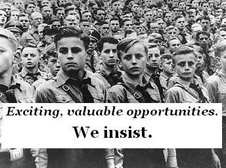
Let us assume that what this author implies (and what anecdotal data, rather than government reports, suggests) is true, i.e. most state schools constitute a punishment for those unfortunate enough to have to attend them. What does this say about the motivations of those responsible for creating and perpetuating this system? Do they really want to create “exciting, valuable” opportunities? Or are they not that bothered if the lives of intelligent children whose parents are unable to send them to a private school (because they have had 40 per cent of their spending power confiscated to pay for — among other things — an unworkable state education system) are messed up?

Fabian